
Muslims Projected to Outnumber Christians by 2035 — Yet Christianity Keeps Growing
For centuries, Christianity has been the largest religion in the world. That is expected to change within the next decade, according to new projections from the Pew Research Center released on Wednesday.
Pew projects that Muslims will surpass Christians in population by 2035, becoming the world's largest religious group. The shift is driven mainly by birth rates: Muslims are having more children than any other major religious group. But the report also carries a second, quieter finding — Christianity is not shrinking. Both faiths are projected to keep growing in the decades ahead.
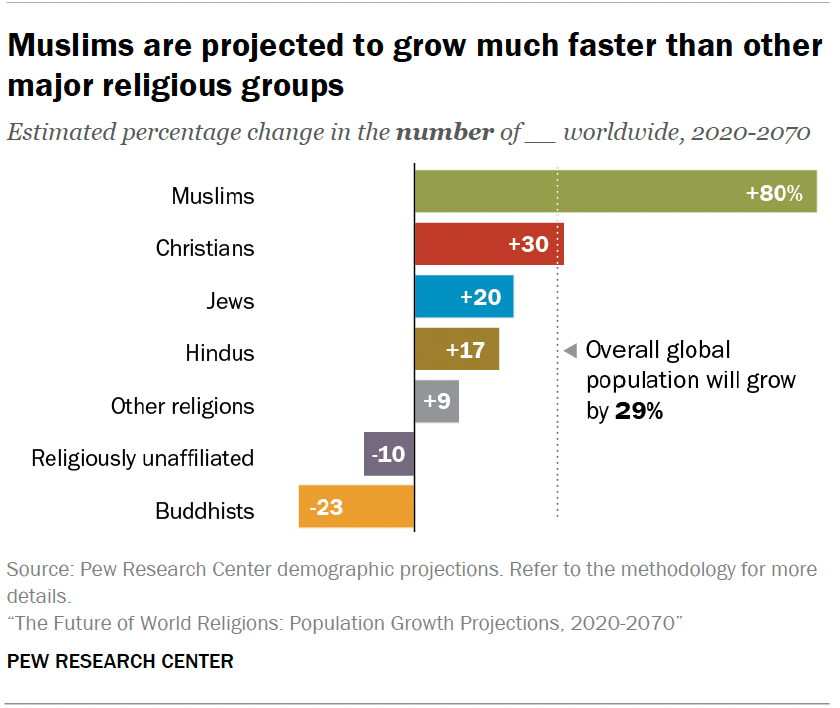
By 2070, if recent trends continue, the world could have more than 3.6 billion Muslims and just under 3 billion Christians, Pew said. The world's total population is expected to grow by 29 percent between 2020 and 2070. Muslims are projected to grow by 80 percent over that period, while Christians grow by 30 percent — the only two major religious groups expected to keep pace with overall population growth.
The main driver is what Pew calls natural population change — births minus deaths. Between 2020 and 2070, Muslims are projected to gain 1.6 billion people through natural increase, compared with 792 million for Christians. In the 2020-2025 period, the total fertility rate was 3.1 children per Muslim woman and 2.5 per Christian woman, against 1.6 for all other women combined. A generation typically replaces itself at about 2.1 children per woman.
Religious switching will also play a part, though a smaller one. Based on past trends, Muslims are expected to lose a net 8 million people through switching over the projection period, while Christians are projected to lose a net 105 million, most of them becoming religiously unaffiliated. Movement between the two faiths is expected to roughly even out: about 9.2 million Muslims are projected to become Christian, and about 9 million Christians to become Muslim. In other words, Islam's projected growth is not driven by converts from Christianity.
Much of the growth will be concentrated where each faith is already strong. Most of the growth in the Muslim population is expected in the 53 countries where Muslims were already a majority in 2020. Pakistan's Muslim population, for example, is expected to double from 227 million in 2020 to 461 million in 2070, making it the country with the world's largest Muslim population. Christian growth will likewise be concentrated in the 120 countries where Christians were a majority, accounting for 92 percent of global Christian growth. In the Democratic Republic of the Congo, the Christian population is expected to triple, from 92 million to 299 million.
Not every Christian population is growing. The United States, which had the world's largest Christian population in 2020, is expected to see the greatest decline, falling from 217 million Christians to 174 million by 2070, largely because of disaffiliation and an aging population. In sub-Saharan Africa, the number of Christians is expected to grow 129 percent between 2020 and 2070 — yet the number of Muslims there is expected to rise even faster, by 166 percent.
Regionally, Christians are projected to remain the largest religious group in most parts of the world, though their share will decline nearly everywhere except the Asia-Pacific region, where it is expected to hold steady. The only region where the largest religious group is projected to change by 2070 is Asia-Pacific, where Muslims are expected to surpass the religiously unaffiliated.
Pew stresses that these are projections, not certainties. They assume that current patterns in fertility, mortality, migration, and religious switching will continue, and they do not account for wars, epidemics, natural disasters, or other events that could change the course of history. The study covers 201 countries and territories, representing 99.98 percent of the world's population, and draws on national censuses, surveys, United Nations population data, and migration estimates.
The numbers tell a story of a world that is becoming more religiously diverse and more crowded with neighbors of a different faith — and of a Christian church whose greatest growth is increasingly in Africa and the Global South. For the church, the question is not whether the harvest is shrinking, but whether believers will be faithful to reach it.
Read the original at Pew Research Center.